How to Stand Out in a Stack of 500 Job Applications
Competing against hundreds of applicants? Use these 10 proven tactics — including a portfolio website — to rise above the noise and land more interviews.

You submit an application. So do 499 other people.
The recruiter spends maybe 7 seconds on each resume. That's less than four minutes to scan all 500.
Most applications never get read. Not because they're bad—because there's no reason to stop scrolling.
Here's how to be the reason they stop.
Why Most Job Applications Fail
Before tactics, understand the problem.
The Volume Problem
Popular job postings receive hundreds of applications within hours. Remote-friendly roles at known companies can hit thousands.
Recruiters are drowning. They're not looking for reasons to say yes. They're looking for reasons to say no—quickly.
The Sameness Problem
Most applications look identical:
- Same resume format
- Same generic cover letters ("I'm excited to apply...")
- Same buzzwords ("results-driven," "team player," "passionate")
- Same absence of proof
When everyone looks the same, nobody stands out.
The Relevance Problem
Applicants spray and pray. They apply to everything vaguely related, customizing nothing.
Recruiters spot generic applications instantly. Mass-applied, mass-rejected.
10 Tactics That Actually Work
1. Lead With a Portfolio Website
A link to your portfolio website or personal website changes the dynamic immediately.
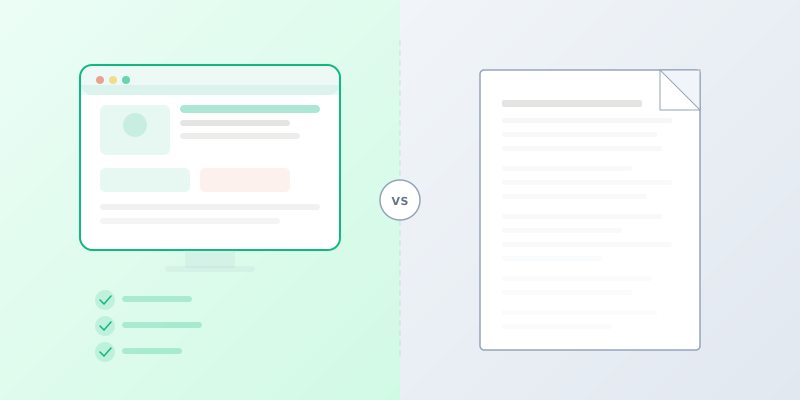
Instead of: "Here's a PDF that looks like every other PDF" It becomes: "Here's a living, breathing presence you can explore"
Your website does things a resume can't:
- Shows personality and taste
- Displays work visually
- Demonstrates modern skills
- Invites deeper exploration
Include the link prominently—in your resume header, your email signature, your cover letter opening.
AI-powered personal website builders like Pastefolio let you create a professional website in minutes. The AI reads your resume, extracts your experience, and generates a polished portfolio website automatically. Paste your resume content, select a template, and you're live.
2. Customize for the Specific Role
Not a different resume for every application—that's unsustainable. But targeted customization matters.
For the resume:
- Reorder bullet points to lead with relevant experience
- Mirror language from the job description (their words, your experience)
- Add a brief objective/summary tailored to this specific role
For the cover letter:
- Reference the specific company and role
- Connect your experience to their stated needs
- Mention something specific about the company (recent news, product, mission)
This takes 10 extra minutes. It's the difference between considered and ignored.
3. Show, Don't Tell
"Excellent communication skills" means nothing. Everyone claims it.
Instead:
- Link to a blog post you wrote
- Mention a presentation you gave
- Reference documentation you created
"Increased sales" is vague. "Increased Q3 sales by 34% through new outbound strategy" is memorable.
Proof beats assertion every time.
4. Apply Early
Most applications arrive in the first 48 hours after posting. But the earliest applications often get the most attention.
Recruiters often start reviewing immediately. If you're in the first 50 applications, you're competing with 50 people, not 500.
Set up job alerts. Move fast.
5. Reference Someone Inside
"Jane Smith suggested I apply" transforms your application. You're no longer a stranger—you're a referral.
Even weak connections help:
- "I met your CTO at a conference last month"
- "I noticed your teammate's post about this role on LinkedIn"
- "A mutual connection at [Company] mentioned you were hiring"
If you know someone at the company, say so immediately.
6. Follow Up Strategically
After applying, don't just wait.
Find the hiring manager on LinkedIn. Send a brief connection request with a note: "Just applied for [Role] at [Company]. Looking forward to the opportunity to discuss how my experience in [X] could help with [Y]."
Follow up by email after one week. Brief, professional, not pushy: "Wanted to reiterate my interest in [Role]. Happy to provide any additional information."
This isn't desperate. It's persistent. There's a difference.
7. Make Your Resume Scannable
Recruiters don't read resumes. They scan them.
Optimize for 7-second review:
- Name and title prominent at top
- Clear section headers
- Bullet points, not paragraphs
- Key achievements in bold
- Consistent, clean formatting
Put the best stuff first. Your most impressive achievement should be visible without scrolling.
8. Kill the Generic Opening
"Dear Hiring Manager" tells them you don't know who they are. "I'm excited to apply" tells them nothing.
Better: Start with a specific, relevant statement.
"When I read about [Company]'s approach to [problem], I knew I could contribute—I've spent three years solving exactly this type of challenge at [Previous Company]."
Intrigue them in the first sentence or lose them.
9. Be Findable
Recruiters Google candidates. Control what they find.
- Your personal website should rank for your name
- Your LinkedIn should be complete and professional
- Your GitHub should be active (if relevant)
- Your social media should be clean (or private)
If they can't find you, they get nervous. If they find something concerning, you're out.
10. Apply to Fewer Jobs, Better
Spraying 100 generic applications is less effective than sending 20 targeted ones.
For each application, you should be able to answer:
- Why this specific company?
- Why this specific role?
- What specifically do you bring?
If you can't answer these, you're wasting your time.
The Numbers Game Myth
"It's a numbers game—apply to everything" is terrible advice.
Volume without quality generates rejections, not interviews. You demoralize yourself and train algorithms to deprioritize your applications.
The real strategy: High relevance, high quality, moderate volume.
Focus on roles where you're genuinely qualified, at companies you actually want to join, with applications that demonstrate real interest.
When You're Underqualified
Job requirements are wish lists, not requirements.
If you match 60-70% of the stated qualifications, apply. But address the gap:
- Acknowledge what you're still learning
- Highlight related experience that transfers
- Demonstrate enthusiasm to grow
"I don't have direct experience with X, but my work with Y has given me a strong foundation, and I'm committed to ramping up quickly."
Self-awareness beats fake confidence.
The Application as a Work Sample
Every touchpoint is an evaluation:
- Your email is a writing sample
- Your resume is a design sample
- Your website is a professionalism sample
- Your follow-up is a communication sample
Nothing is throwaway. Everything is evidence of how you work.
Standing Out Is a Choice
Most applicants take the path of least resistance. They submit the minimum. They customize nothing. They hope volume compensates for quality.
This creates your opportunity.
Every moment of extra effort—a tailored cover letter, a portfolio link, a thoughtful follow-up—separates you from the crowd.
The recruiter scanning 500 applications is looking for a reason to stop. Be that reason.
Your application isn't a lottery ticket. It's a case you're building. Build it well — and let your online resume do the heavy lifting.
Stand out to recruiters
Get a professional online presence in minutes.
Stand out to recruiters
Get a professional online presence in minutes.
Topics covered