ChatGPT Resume Review: 5 Prompts That Actually Work (and What They Miss)
How to get a genuinely useful resume review from ChatGPT: 5 copy-paste prompts, the mistakes that ruin the feedback, and the four things ChatGPT can't check.
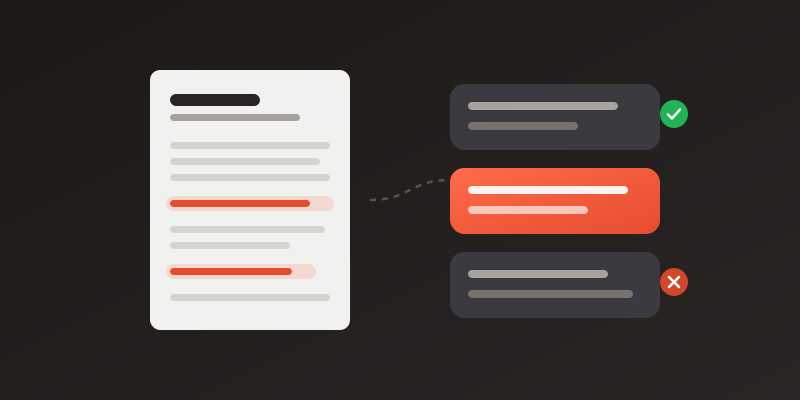
Asking ChatGPT to review your resume is a good idea. Most people just do it badly.
They paste their resume, type "review my resume", and get back a polite sandwich: two compliments, three vague suggestions ("consider quantifying your achievements"), and a closing pep talk. It feels like feedback. It changes nothing.
The problem isn't the model. It's the prompt. ChatGPT has read millions of resumes and hiring discussions, and it will give you sharp, specific criticism if you force it to. Here are the five prompts we've seen work best, in the order you should run them, plus the four blind spots no prompt can fix.
Before you paste anything
Three things worth knowing first.
ChatGPT only sees your words, not your layout. When you paste a resume as text (or upload a PDF that gets converted to text), the visual layer disappears. Margins, columns, font choices, that awkward page break in the middle of your best job: invisible. Whatever feedback you get, it says nothing about how your resume looks. Keep that in mind for later.
Context changes everything. "Review my resume" gets generic advice. "Review my resume for a senior product manager role at a B2B SaaS company" gets targeted advice. Every prompt below starts with context for that reason.
You can redact. If pasting your employer names or phone number into a chatbot bothers you, replace them with placeholders ("[Company A], a 200-person fintech"). The feedback quality barely changes.
Prompt 1: the harsh first read
Start by removing ChatGPT's default politeness. That's the single biggest upgrade you can make.
You are a hiring manager for [target role] at [type of company]. You have 200 applications and no patience. Read the resume below and tell me: (1) the three biggest reasons you would reject it, (2) what the resume seems to position me as, in one sentence, and (3) whether that positioning matches [target role]. Be blunt. Do not compliment me. Do not soften anything.
[paste resume]
The second question is the important one. If ChatGPT summarizes you as "a generalist with broad experience" and you're applying for a specialist role, that's the same conclusion a recruiter reaches in ten seconds. You've just learned your resume has a positioning problem, not a wording problem.
Prompt 2: rewrite your bullets around results
Weak bullets describe activity ("Responsible for managing the product roadmap"). Strong bullets describe impact ("Reprioritized the roadmap around churn drivers; retention improved 12% in two quarters"). ChatGPT is genuinely good at this transformation, with one serious caveat we'll get to.
Here are the bullet points from my last two roles. For each one, tell me whether it describes a responsibility or a result. Rewrite each responsibility bullet as a result bullet using this structure: action, method, measurable outcome. Where a number is missing, do NOT invent one. Instead, write [METRIC?] and ask me a question that would help me find the real number.
[paste bullets]
Answer its questions with real numbers, then ask it to finalize the bullets. This back-and-forth is where the actual value is. The first draft never is.
Prompt 3: match against a real job description
This is the highest-leverage prompt of the five, and almost nobody uses it.
Below are my resume and a job description. List: (1) the requirements in the job description that my resume clearly demonstrates, (2) the requirements it mentions weakly or indirectly, (3) the requirements it doesn't address at all, and (4) the experience on my resume that is irrelevant to this job and could be cut or shortened. Then suggest how to reorder my bullets so the most relevant evidence appears first.
Resume: [paste] Job description: [paste]
Run this for every application that matters. The uncomfortable pattern you'll notice: a resume that's "good" in general is mediocre for any specific job. Tailoring beats polishing, every time.
Prompt 4: the six-second skim
Recruiters famously spend a handful of seconds on a first pass. You can simulate that pass.
Read only the top third of my resume: name, headline, and the first three bullets. Based on that alone, answer: What role is this person applying for? What is their level? What is the one thing they seem best at? Now tell me what I would need to change so that a reader gets the answer I want ([your intended positioning]) in under ten seconds.
[paste resume]
If the simulated skim gets your level or specialty wrong, your real skims are going wrong too. Fix the top third before anything else; it's the only part most readers ever see.
Prompt 5: the ruthless cut
Long resumes usually aren't thorough. They're unedited.
My resume is [X] pages. Identify everything that could be cut with no loss of signal for a [target role] application: outdated roles, redundant bullets, filler skills, empty phrases like "team player" or "results-driven". For each cut, give a one-line justification. Be aggressive. Then show me what the one-page version would keep.
[paste resume]
You won't accept every cut, and that's fine. But you'll discover how much of your resume is there out of habit rather than evidence.
What ChatGPT can't tell you
Used well, these prompts will genuinely improve your resume. Now the honest part: four things sit outside what any chat prompt can do.
1. It has no benchmark. ChatGPT can say your resume is "strong". It cannot say whether it's stronger than the other 200 people applying for the same role, because it isn't comparing you to anyone. There's no percentile, no baseline, no way to know if "strong" means top 10% or dead average. All feedback is absolute, and absolute feedback flatters.
2. It can't see your resume. As covered above: layout, typography, white space, scannability. A resume can have perfect wording and still fail because it's a dense wall of nine-point text. ChatGPT will never catch that.
3. Its grading drifts. Ask for a score out of 100 today and you might get 74. Same resume, new session, tomorrow: 81. The criteria shift with the conversation. That's fine for directional feedback, useless for tracking whether your edits actually made things better.
4. It stops at advice. After the review, you're holding the same file, just better worded. The gap between "my resume is improved" and "a hiring manager can see who I am" is still yours to close.
After the review: give the resume somewhere to go
The five prompts above fix your wording. Points one to four are the reason we built Pastefolio the way we did: instead of another block of text feedback, your resume becomes something a recruiter can actually look at.
Paste your improved resume and it becomes a clean, professionally designed personal page in about a minute. The layout problem is handled by design, not by you. And when the resume-vs-online-presence question comes up in your search (it will), you're already on the right side of it. We've written before about why an online resume outperforms a PDF and how the resume-to-website process works if you want the details.
Use ChatGPT for the words. Then give the words a place to live.
Quick answers
Is it safe to paste my resume into ChatGPT? A resume is mostly information you're actively trying to publish. If specific details bother you (phone, address, current employer), redact them; the feedback barely suffers. Check your ChatGPT data settings if you don't want conversations used for training.
Can ChatGPT write my resume from scratch? It can, and it will sound like it. Generic AI-written resumes are increasingly easy for recruiters to spot. Use it as an editor of your real experience, not an author of an imaginary one.
Do I need the paid version? No. The free tier handles all five prompts. Paid models give somewhat sharper critique on long resumes, but the prompt quality matters far more than the model tier.
Stand out to recruiters
Get a professional online presence in minutes.
Stand out to recruiters
Get a professional online presence in minutes.
Topics covered